
Which are the correct control inputs when taxiing?
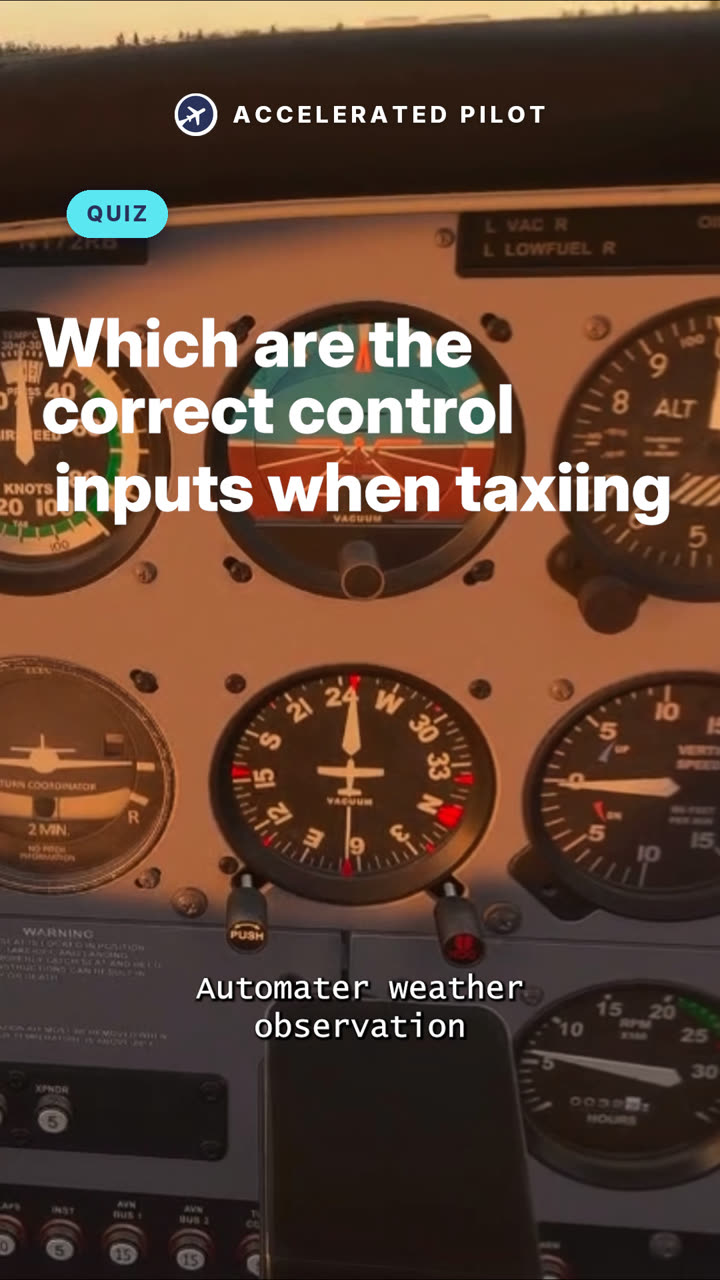
Checkride Quiz: You're taxiing at Hudson Valley Regional (KPOU) on a heading of 243. The ASOS reports wind 350 at 12, gusting 20. Which are the correct control inputs when taxiing?
Pick an answer. You can try as many as you like.
Read the full explanation
A. Yoke left and forward
Find the wind relative to the nose
Start by finding where the wind is coming from compared to the direction you're taxiing. The wind is from 350 and the heading is 243, so the wind is 107 degrees to the right of the nose. This is a right quartering tailwind.
The ASOS broadcast gives the wind in magnetic, the same reference as the heading indicator, so the two numbers can be compared directly. Written reports such as METARs and TAFs give the wind in true. The mnemonic is "if it's written, it's true, if it's spoken, it's magnetic".
Control positions for a quartering tailwind
The Airplane Flying Handbook calls for the elevator DOWN and the upwind aileron DOWN when taxiing with a quartering tailwind. With the wind striking the airplane from behind, these control positions reduce the tendency of the wind to get under the tail and the wing and to nose the airplane over.
- Elevator down means the yoke is pushed forward.
- The wind is from the right, so the right aileron goes down. Turning the yoke left lowers the right aileron.
That's yoke left and forward. The mnemonic is "turn into a headwind, dive away from a tailwind".
References
- Airplane Flying Handbook (FAA-H-8083-3C), Chapter 2: Ground Operations PDFSee Taxiing, page 2-19, and Figure 2-15, Control positions of the nosewheel airplane, on page 2-20.
Share your thoughts / Suggest a quiz
Tell us what you thought of this quiz, or suggest a topic for a future one.
Fly the syllabus at your own pace. Practice in VR and impress your flight instructor with how fast you improve.