
What does the yellow arc mean?
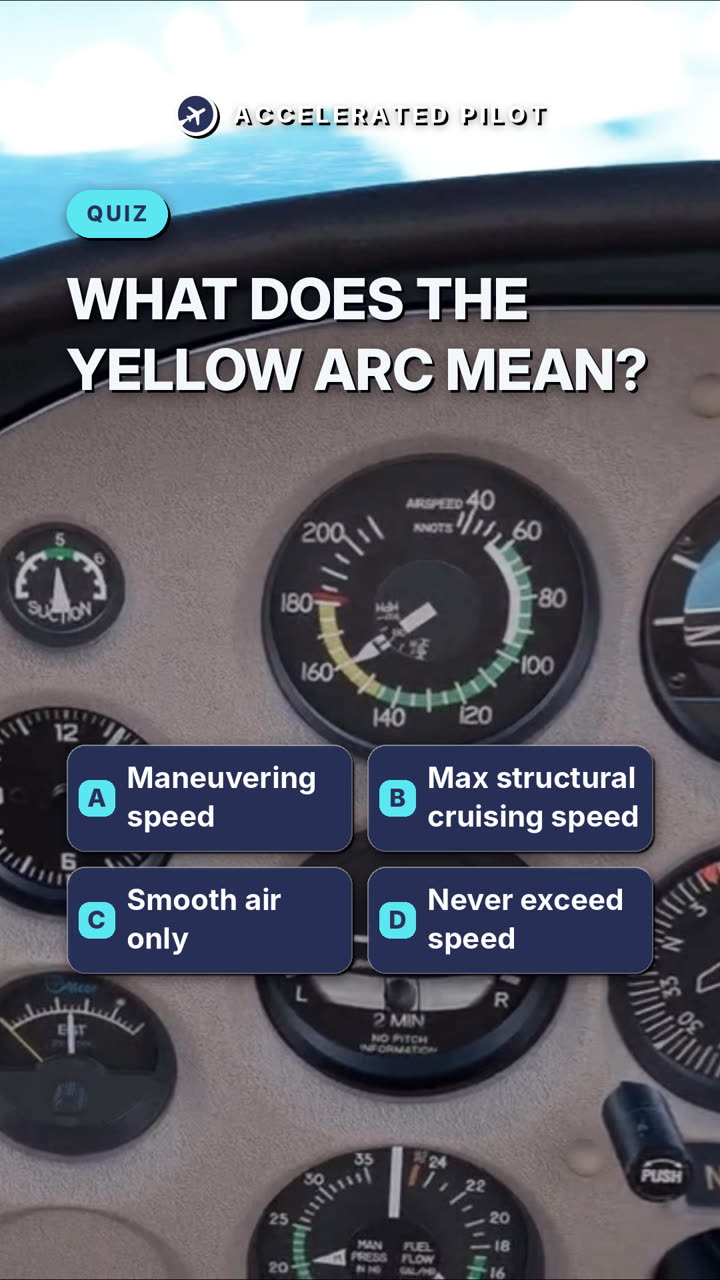
What does the yellow arc on the airspeed indicator mean?
Pick an answer. You can try as many as you like.
Read the full explanation
C. Smooth air only
The airspeed indicator markings
The airspeed indicator has several color-coded markings and arcs. Each colored arc marks a range of speeds, and the ends of each range mark specific V-speeds.
- White arc -- The flap operating range. The bottom is Vs0, the stall speed in the landing configuration. The top is the maximum flap extended speed.
- Green arc -- The normal operating range. The bottom is Vs1, the stall speed in a specified configuration. The top is Vno, the maximum structural cruising speed.
- Yellow arc -- The caution range, from Vno up to Vne. Fly in it only in smooth air, and then only with caution.
- Red line -- Vne, the never exceed speed. Operating above it can cause damage or structural failure.
Why smooth air only
In the yellow arc, the airplane is fast enough that a strong gust can push the load factor past the airplane's structural limits. Smooth air has no gusts, so the range can be used with caution. If you hit turbulence in the yellow arc, reduce power and slow into the green arc.
Speeds that aren't marked
Maneuvering speed (Va) isn't marked on the airspeed indicator, because it varies with weight. Va decreases as weight decreases. It's published in the POH, and it's in the green arc.
References
- Pilot's Handbook of Aeronautical Knowledge (FAA-H-8083-25C)See Chapter 8, Flight Instruments, page 8-9: Airspeed Indicator Markings.
Share your thoughts / Suggest a quiz
Tell us what you thought of this quiz, or suggest a topic for a future one.

Fly the syllabus at your own pace. Practice in VR and impress your flight instructor with how fast you improve.