
Spot what's failed?
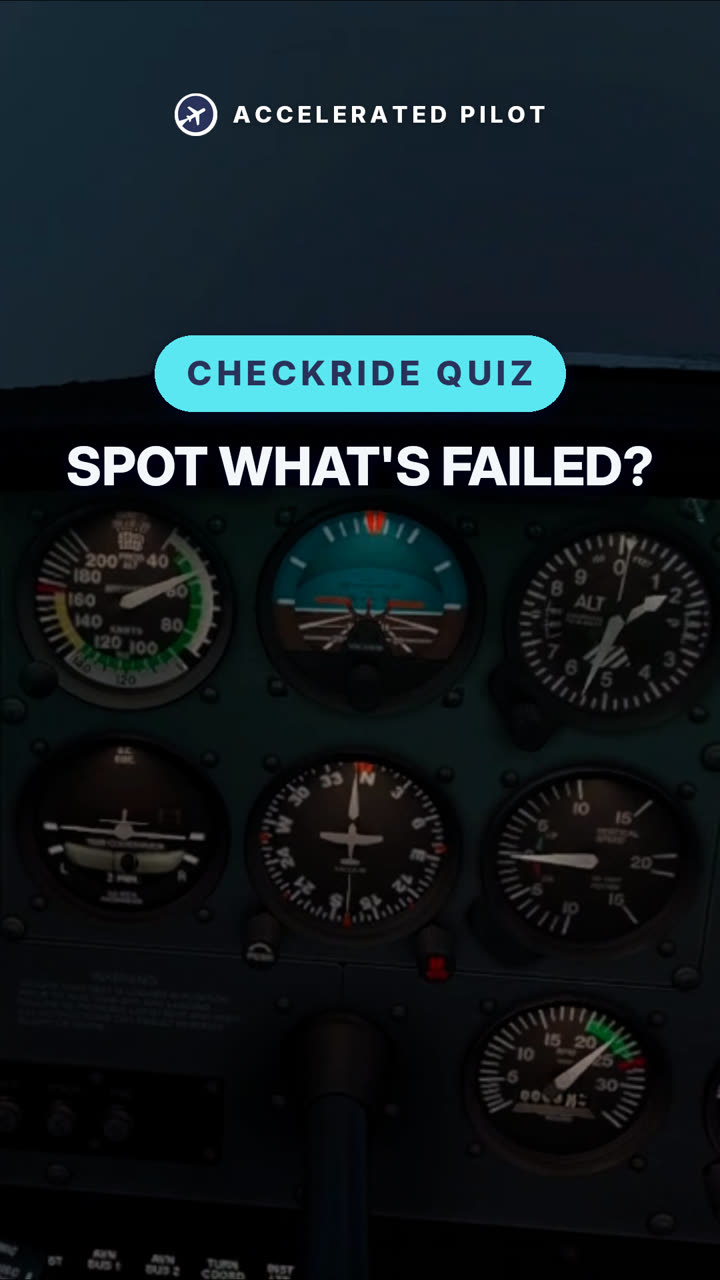
Full power. The magnetic compass confirms you are maintaining a constant heading. Here's the view of the instruments -- can you spot the failure?
Pick an answer. You can try as many as you like.
Read the full explanation
B. Static port
What the instruments show
The power is full and the magnetic compass shows a constant heading. The heading indicator holds steady and the turn coordinator shows wings level, so we're flying straight ahead. The attitude indicator shows a pitch up, and the airspeed indicator shows the airspeed declining. At full power, airspeed only declines with the nose up in a climb.
The altimeter and the VSI disagree. The altimeter is frozen and the VSI reads zero, as if we were in level flight.
Why it's the static port
The altimeter, VSI and airspeed indicator all take their pressure from the static port. When the port is blocked, the trapped static pressure freezes the altimeter at the altitude where the blockage occurred, and the VSI shows a continuous zero.
The airspeed indicator uses static pressure too. In a climb with the static port blocked, it shows less airspeed than you actually have, and the indication keeps decreasing as the climb continues. In a descent it reads high.
When two instruments fail together, look for the source they share. Here that's the static port.
Ruling out the others
- Vacuum pump: a vacuum failure affects the attitude indicator and the heading indicator. The heading indicator agrees with the turn coordinator and the compass, and the pitch on the attitude indicator agrees with the declining airspeed.
- Pitot tube: a blocked pitot tube affects only the airspeed indicator. With the drain hole open it reads zero. It can't freeze the altimeter or hold the VSI on zero.
- ASI: the airspeed indicator is reading low, but that's a symptom of the blocked static port, not a failure of the instrument itself. A failed airspeed indicator wouldn't freeze the altimeter or the VSI.
What to do about it
Many airplanes have an alternate static source inside the cabin. Because cabin pressure is slightly lower than outside, the altimeter reads slightly high, the airspeed indicator reads high, and the VSI shows a momentary climb before it settles. Without an alternate source, breaking the VSI glass lets cabin air into the static system. That most likely puts the VSI out of service, which is why the VSI is the one chosen.
References
- Pilot's Handbook of Aeronautical Knowledge (FAA-H-8083-25C), Chapter 8 PDFSee Blocked Static System on page 8-11, and Alternate Static Source on pages 8-2 and 8-3.
Share your thoughts / Suggest a quiz
Tell us what you thought of this quiz, or suggest a topic for a future one.
Fly the syllabus at your own pace. Practice in VR and impress your flight instructor with how fast you improve.