
Carb heat on, RPM drop & recover. Why?
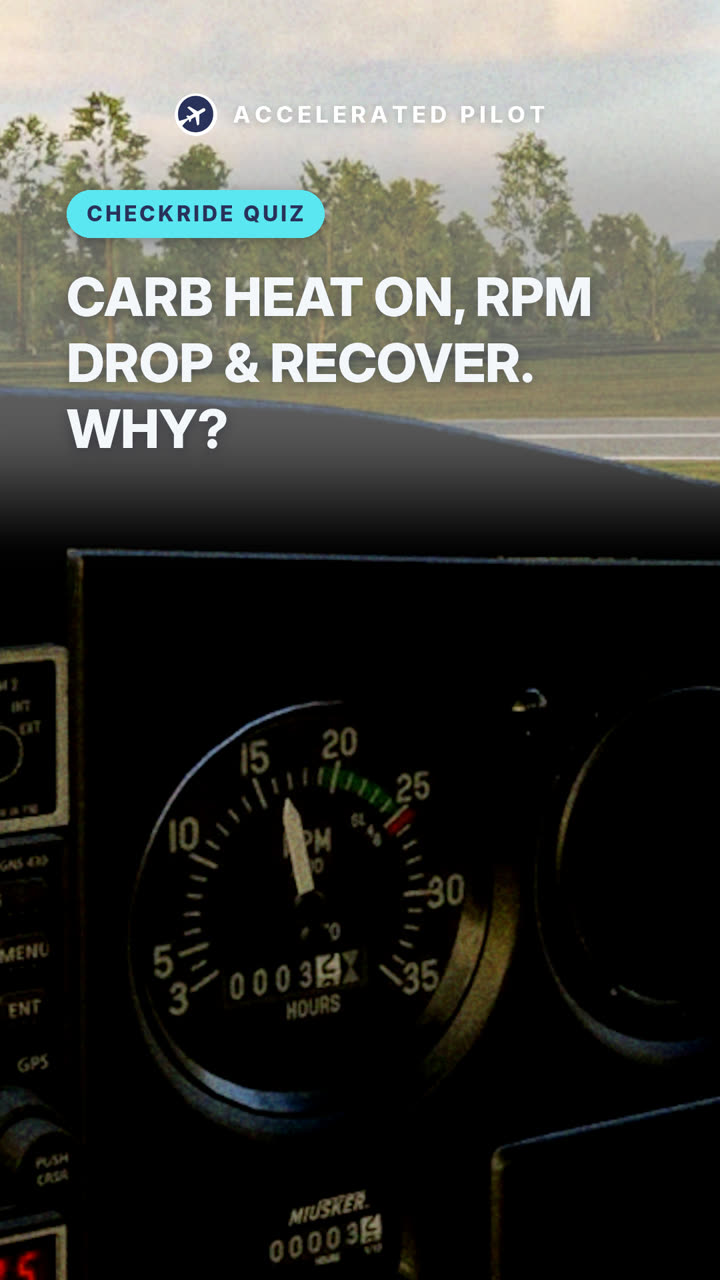
During runup, you see an excessive RPM drop during the carburetor heat check, followed by some engine roughness, then a slow rise. Why?
Pick an answer. You can try as many as you like.
Read the full explanation
B. Carb ice
What the carb heat check shows
During the runup, applying carb heat routes heated air from around the exhaust into the carburetor. Heated air is less dense, so an airplane with a fixed-pitch propeller shows a drop in RPM. A normal drop tells you the carb heat system is working.
What carb ice looks like
If there is no ice, the RPM drops 50 to 100 RPM and stays steady until you set carb heat to cold. If ice is present, the RPM drops more significantly, and the engine runs rough as the ice melts and water is ingested into combustion. After all the ice is melted, the RPM rises back to normal.
By the way, carb ice doesn't only form in cold weather. The PHAK puts the highest risk at temperatures below 70 °F (21 °C) with relative humidity above 80 percent.
Why not the others
- Bad magneto -- the mag check is done separately. Applying carb heat has no effect on the magnetos.
- Fuel contamination -- water or contaminated fuel can make the engine run rough, but it's unlikely the contaminant would be consumed during the carb heat check. The RPM recovering within a few seconds points elsewhere.
- Detonation -- a high power, high temperature problem, usually from too lean a mixture or the wrong grade of fuel. At runup power it isn't a factor, and carb heat makes the mixture richer, not leaner.
What about a rich mixture?
Carb heat richens the mixture, so at a high elevation field with the mixture full rich the drop can be bigger than usual. In that case the RPM holds steady at the lower number. It doesn't drop, run rough and then recover.
References
- Pilot's Handbook of Aeronautical Knowledge (FAA-H-8083-25C), Chapter 7: Aircraft Systems PDFSee Carburetor Icing, pages 7-9 and 7-10.
Share your thoughts / Suggest a quiz
Tell us what you thought of this quiz, or suggest a topic for a future one.

Fly the syllabus at your own pace. Practice in VR and impress your flight instructor with how fast you improve.