
What just happened on short final?
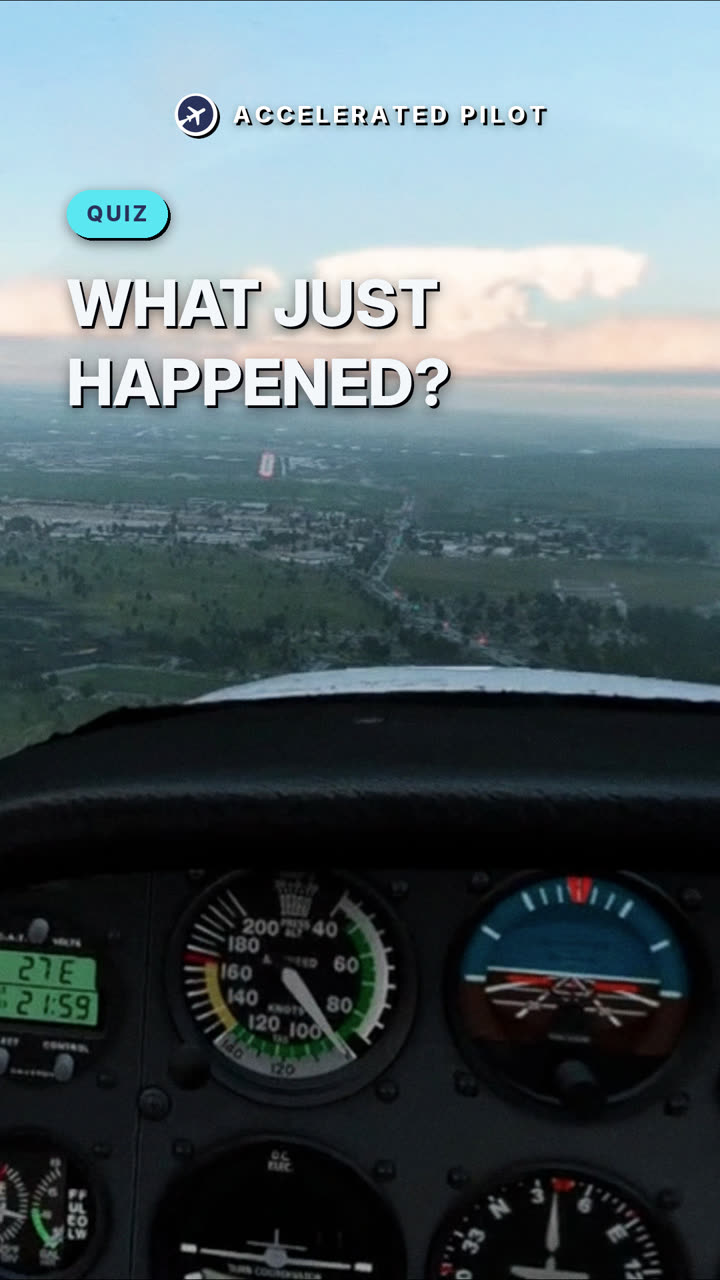
Short final, stable approach to land, storms visible in the distance. Suddenly the airspeed indicator increases by 30 knots, followed by a drop of 60 knots. What just happened?
Pick an answer. You can try as many as you like.
Read the full explanation
C. Flew into a microburst
What the airspeed indicator showed
A microburst is a small, intense downdraft that hits the ground and spreads out in every direction. An airplane flying through one meets the outflow in three stages. First comes a headwind, which raises the indicated airspeed and lifts the airplane above its path. Next comes the downdraft. Last comes a tailwind, which takes the airspeed away again. The 30-knot gain followed by a 60-knot drop from the peak is that sequence: a 30-knot headwind that turned into a 30-knot tailwind, a 60-knot shear in a few seconds.
Why storms in the distance still matter
The AIM describes the downdraft as typically less than a mile across, with the outflow at the surface spreading out to about 2 1/2 miles. Downdrafts can reach 6,000 feet per minute, and the horizontal winds can reach 45 knots, which means a 90-knot shear from one side of the microburst to the other. A microburst gets stronger for about 5 minutes after it reaches the ground, and once one starts, more in the same area should be expected. They also come from weak-looking convective cells with little or no rain reaching the ground, not only from the storm itself.
What to do about it
The sudden airspeed gain is the warning. The natural reaction is to reduce power and lower the nose to get back on speed and on the glide path. That leaves the airplane low on power and nose low just as the tailwind and downdraft arrive, with little altitude to recover. Treat an unexpected gain near convective weather as the cue to go around with full power, and the best defense is to stay away from the storms in the first place.
References
- Pilot's Handbook of Aeronautical Knowledge, Chapter 12: Weather Theory PDFSee the Low-Level Wind Shear section and the microburst figure.
- Aeronautical Information Manual, Chapter 7, Section 1: MeteorologySee paragraph 7-1-24, Microbursts.
- Aeronautical Information Manual, Chapter 7, Section 4: Wake TurbulenceSee paragraph 7-4-3, Vortex Strength, for induced roll.
Share your thoughts / Suggest a quiz
Tell us what you thought of this quiz, or suggest a topic for a future one.


Fly the syllabus at your own pace. Practice in VR and impress your flight instructor with how fast you improve.