
How can we increase our climb?
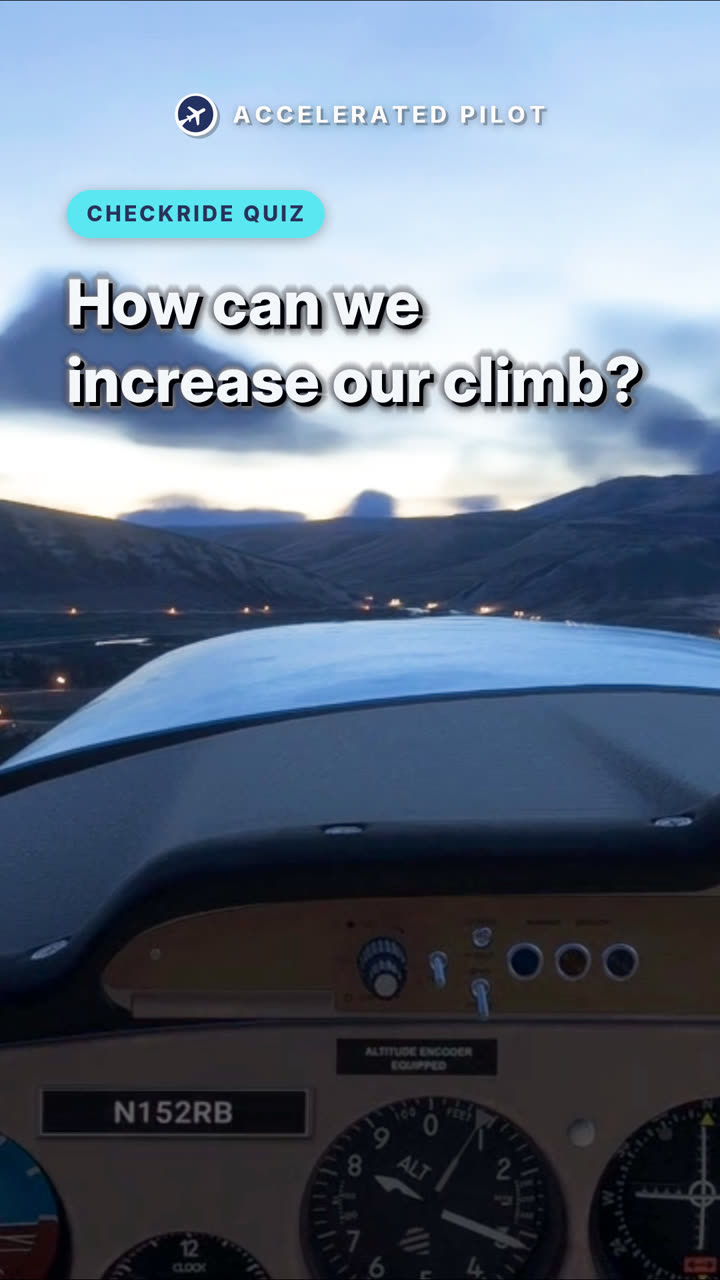
We've just departed Granby-Grand County Airport, with an elevation of 8,207, flying towards rising terrain in our Cessna 152 Aerobat. Our climb is anemic, even at Vx with full throttle. How can we increase our climb?
Pick an answer. You can try as many as you like.
Read the full explanation
B. Lean the mixture
Why the climb is anemic
Granby-Grand County sits at 8,207 feet, and density altitude is higher still on a warm day. Thin air reduces engine power because the engine takes in less air, and it reduces thrust because the propeller is less efficient. The result is airplane performance diminishes with altitude.
Leaning the mixture
With the mixture full rich, the carburetor delivers about the amount of fuel the engine needs at sea level. At high altitude there is less air for that fuel, so the mixture is too rich and the engine loses power. Leaning reduces the fuel flow to match the thinner air and gets back the power the rich mixture was costing. The FAA's Engine Operation for Pilots says to lean during the climb above a density altitude of 5,000 feet, and at high-elevation airports to lean for taxi and takeoff as well. Use the leaning procedure in the POH.
Why the other options don't help
- Pitch up higher. Vx is the best angle-of-climb speed. Pitching above it slows us below Vx, so both the climb angle and the climb rate drop, and we get closer to a stall near rising terrain.
- Add carb heat. Heated air is less dense, so carb heat reduces engine power by up to 15 percent. It also enriches a mixture that is already too rich.
- Add 10° flaps. Flaps increase drag, which costs climb performance at the moment we can least afford it.
What about carb ice?
Carb ice would show as a gradual drop in RPM. We're just a few minutes after takeoff, and we checked for carb ice during the runup. High density altitude is what's robbing performance here.
Why not Vy?
Vy gives the best rate of climb, the greatest altitude in the shortest time. But time is not our challenge, it's distance. We need the greatest altitude in the shortest distance, and that's Vx.
And if the climb still can't keep up?
If the climb can't keep up with the terrain, turning toward lower ground comes first.
References
- Pilot's Handbook of Aeronautical Knowledge, Chapter 7: Aircraft Systems PDFSee Mixture Control on page 7-9 and Carburetor Heat on page 7-10.
- Pilot's Handbook of Aeronautical Knowledge, Chapter 11: Aircraft Performance PDFSee Density Altitude on page 11-3 and climb performance on page 11-8.
- FAA Engine Operation for Pilots (FAA-P-8740-13)Leaning for takeoff and climb at high density altitude.
Share your thoughts / Suggest a quiz
Tell us what you thought of this quiz, or suggest a topic for a future one.

Fly the syllabus at your own pace. Practice in VR and impress your flight instructor with how fast you improve.