
Are you legal to land?
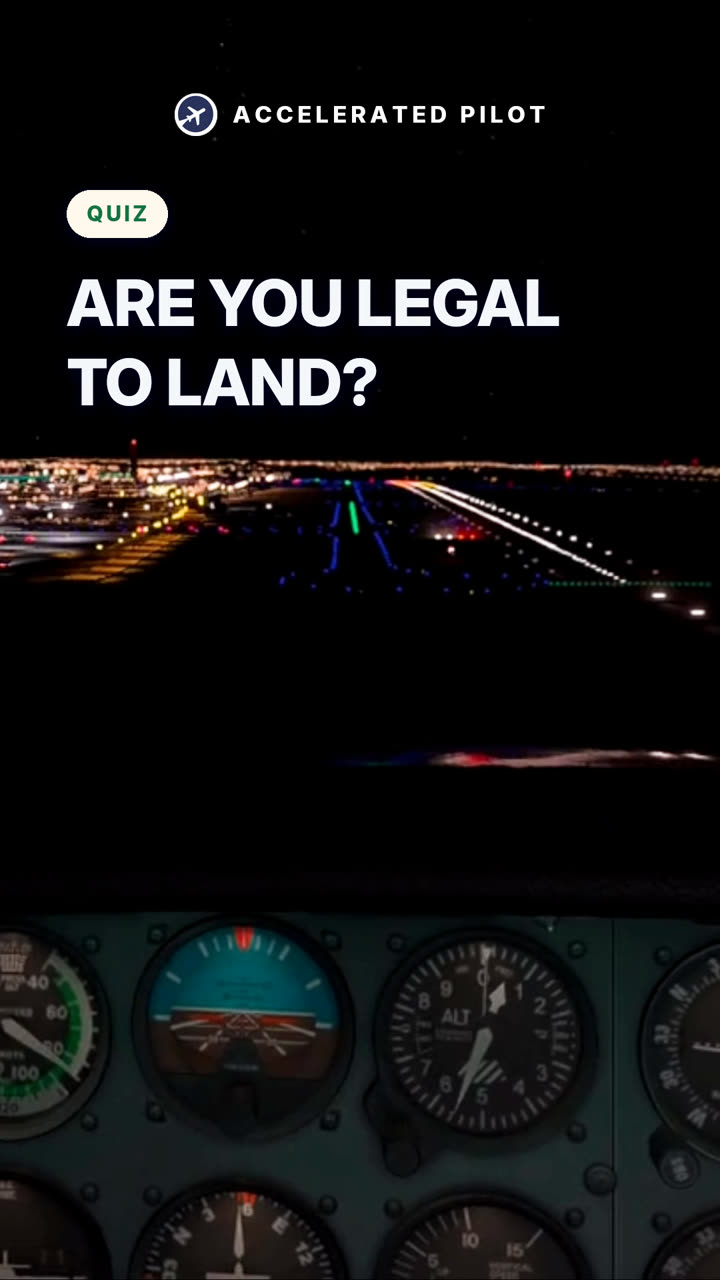
You are Skyhawk 172RB and you're cleared to land Runway 5 left. This is your view on short final. Are you legal to land?
Pick an answer. You can try as many as you like.
Read the full explanation
D. No, that's a taxiway
At night, the airport lighting tells you what you're looking at. Each type of pavement has its own colors.
Runway and taxiway lights
- Runway edge lights -- White. On an instrument runway, yellow replaces white on the last 2,000 feet or half the runway length, whichever is less, as a caution zone.
- Runway threshold lights -- Green, in a row across the approach end of the runway.
- Runway centerline lights -- White, where installed. They change to alternating red and white, then all red, near the far end.
- Taxiway edge lights -- Blue.
- Taxiway centerline lights -- Green.
In the video, the pavement ahead has blue edge lights and green centerline lights. That's a taxiway. The runway with white edge lights is off to the right.
A landing clearance names a runway
At an airport with an operating control tower, you need a clearance from ATC to land (14 CFR 91.129(i)). That clearance is for the runway named in it. Landing on a taxiway, or on the wrong runway, is what the FAA calls a wrong surface landing.
Whose PAPI is that?
A PAPI is normally installed on the left side of its runway. But whether it's on the left or the right, the red lights are always oriented closest to the runway. The PAPI in the video has its red lights on the right, which means it belongs to the runway on the right, 5R.
The AIM also reminds pilots that a PAPI gives vertical guidance only. Lateral guidance comes from the runway and its lights, and you shouldn't descend on the PAPI until you're visually aligned with the runway. And when a runway is served by a PAPI, you must stay at or above the glide path until a lower altitude is necessary for a safe landing (14 CFR 91.129(e)(3)).
Closed runways
A closed runway is marked with a yellow X at each end. A temporary closure may also get a raised, lighted yellow X. When a runway is permanently closed, its lighting circuits are disconnected.
It happens
In July 2017, Air Canada 759 lined up with taxiway C at San Francisco at night, with four airliners waiting on it, and went around at about 60 feet. The parallel runway, 28L, was closed with its lights off, and the crew took 28R for 28L. The NTSB report is worth a read.
References
- Aeronautical Information Manual, Chapter 2, Section 1: Airport Lighting AidsSee 2-1-2 (PAPI), 2-1-4 (Runway Edge Light Systems), 2-1-5 (In-runway Lighting) and 2-1-10 (Taxiway Lights).
- Aeronautical Information Manual, Chapter 2, Section 3: Airport Marking Aids and SignsSee 2-3-6 for closed runway and taxiway markings.
- AC 150/5340-30J, Design and Installation Details for Airport Visual Aids PDFSee paragraph 7.5.4.1.1 on page 7-8 (PAPI on the left side) and Table 7-2 on page 7-12 (the unit nearest the runway is aimed highest).
- 14 CFR 91.129, Operations in Class D airspaceSee (e)(3) for the visual glide path and (i) for landing clearances.
- 14 CFR 91.130, Operations in Class C airspaceParagraph (a) applies 91.129 in Class C airspace.
- NTSB Incident Report AIR-18/01: Air Canada 759, Taxiway Overflight at SFO PDF
Share your thoughts / Suggest a quiz
Tell us what you thought of this quiz, or suggest a topic for a future one.
Fly the syllabus at your own pace. Practice in VR and impress your flight instructor with how fast you improve.