
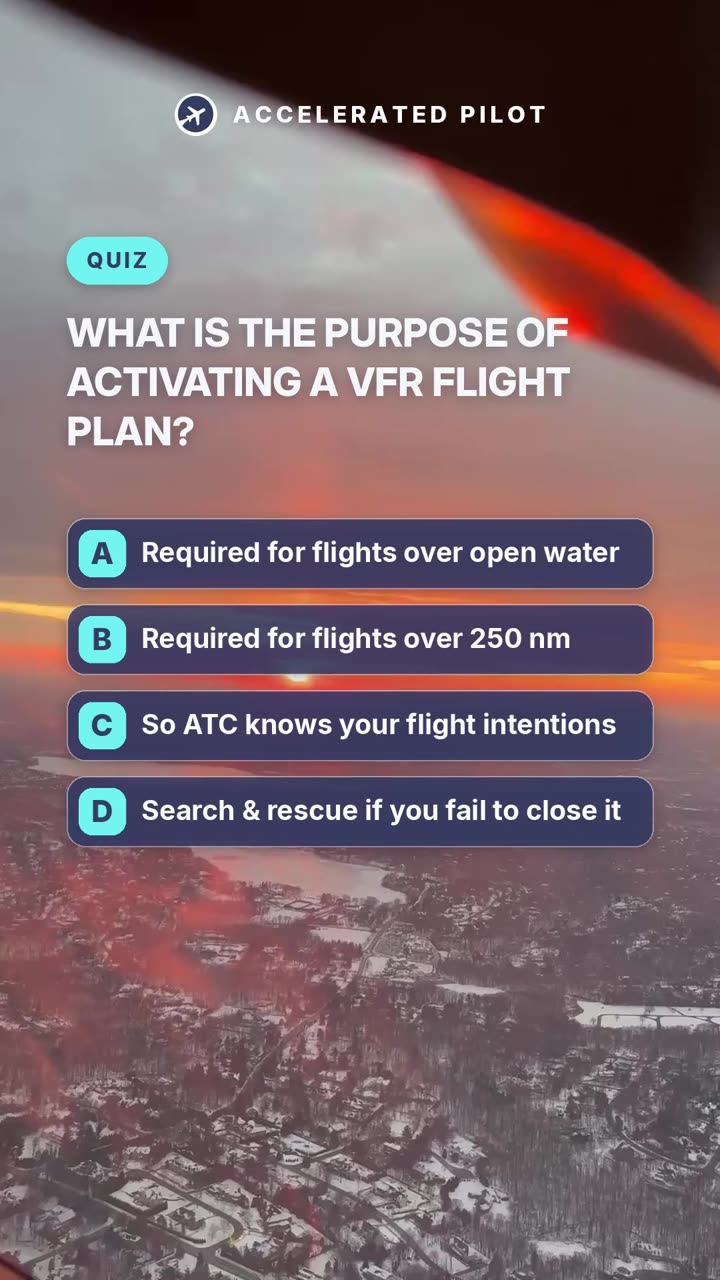
What is the purpose of activating a VFR flight plan?
What is the purpose of activating a VFR flight plan?
Pick an answer. You can try as many as you like.
Read the full explanation
D. Search & rescue if you fail to close it
Filing versus activating
Filing a VFR flight plan with Flight Service doesn't do anything by itself. You have to activate it when you depart. A plan that's filed but never opened just expires, and nobody comes looking.
What happens if you don't close it
Once it's active, the plan is your safety net. If you don't close or extend it within 30 minutes of your ETA, Flight Service starts search and rescue (AIM 5-1-14). The plan tells searchers your route, your fuel on board and who's with you.
No rule requires one
For a domestic VFR flight, no rule requires a flight plan, over water or at any distance. A flight across Long Island Sound or Lake Michigan needs none. The exceptions come from other rules. Crossing an Air Defense Identification Zone requires one (14 CFR 99.11), and so do international flights, such as a trip to the Bahamas (91.703). The 250 nm figure is from the instrument rating cross-country in 61.65, which is flown on an IFR flight plan.
ATC doesn't see it
A VFR flight plan is filed with Flight Service and stays there. ATC can call and ask to see it, but by default they don't receive VFR flight plans, and they learn your intentions only when you call them.
Flight following isn't the same
Flight following is close, but not quite. ATC only provides it workload permitting, and many pilots cancel it in the air once the airport is in sight. That stops anyone from watching the flight. If you have an incident during landing, it could be several hours before someone notices.
References
- Aeronautical Information Manual, Chapter 5, Section 1: PreflightSee 5-1-14, Closing VFR/DVFR Flight Plans.
- Aeronautical Information Manual, Chapter 6, Section 2: Emergency Services Available to PilotsSee the search and rescue paragraphs.
Share your thoughts / Suggest a quiz
Tell us what you thought of this quiz, or suggest a topic for a future one.
Fly the syllabus at your own pace. Practice in VR and impress your flight instructor with how fast you improve.