
Which does ATC not require you to read back?
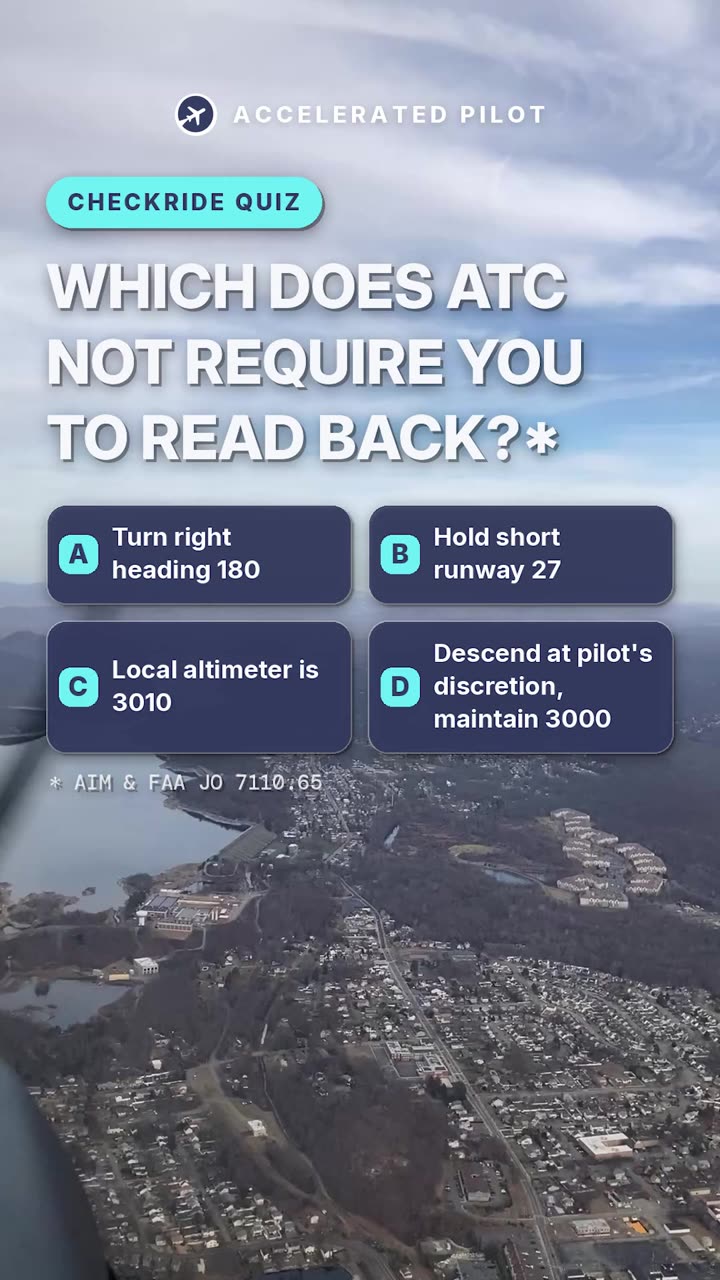
Which does ATC not require you to read back? (Per the AIM and FAA JO 7110.65.)
Pick an answer. You can try as many as you like.
Read the full explanation
C. Local altimeter is 3010
The AIM's readback list
AIM 4-4-7 asks pilots to read back the parts of ATC clearances and instructions that contain altitude assignments, vectors or runway assignments, as a means of mutual verification. A heading is a vector, so "turn right heading 180" gets read back. An altimeter setting isn't on the list, so a simple acknowledgment meets the expectation.
Hold short instructions
Hold short instructions get read back too. AIM 4-3-18 tells pilots to read back any hold short instruction, and the controllers' rulebook, FAA JO 7110.65 (3-7-2), tells them to ask for the readback if you don't give one.
Pilot's discretion
"Descend at pilot's discretion, maintain 3000" sounds optional, but the discretion only covers when you start down and how fast you descend (AIM 4-4-10). The 3000 is still an altitude assignment, and altitude assignments get read back.
Read it back anyway
Reading back the altimeter setting is still a good habit, and plenty of CFIs teach it. Outside the U.S., ICAO rules and countries like the UK do require it, which is why this quiz is specifically about the AIM and JO 7110.65.
References
- Aeronautical Information Manual, Chapter 4, Section 4: ATC Clearances and Aircraft SeparationSee 4-4-7, Pilot Responsibility upon Clearance Issuance, and 4-4-10, Adherence to Clearance.
- Aeronautical Information Manual, Chapter 4, Section 3: Airport OperationsSee 4-3-18, Taxiing.
- FAA JO 7110.65, Chapter 3, Section 7: Taxi and Ground Movement ProceduresSee 3-7-2, Taxi and Ground Movement Operations.
Share your thoughts / Suggest a quiz
Tell us what you thought of this quiz, or suggest a topic for a future one.
Fly the syllabus at your own pace. Practice in VR and impress your flight instructor with how fast you improve.