
What's true about a steep turn?
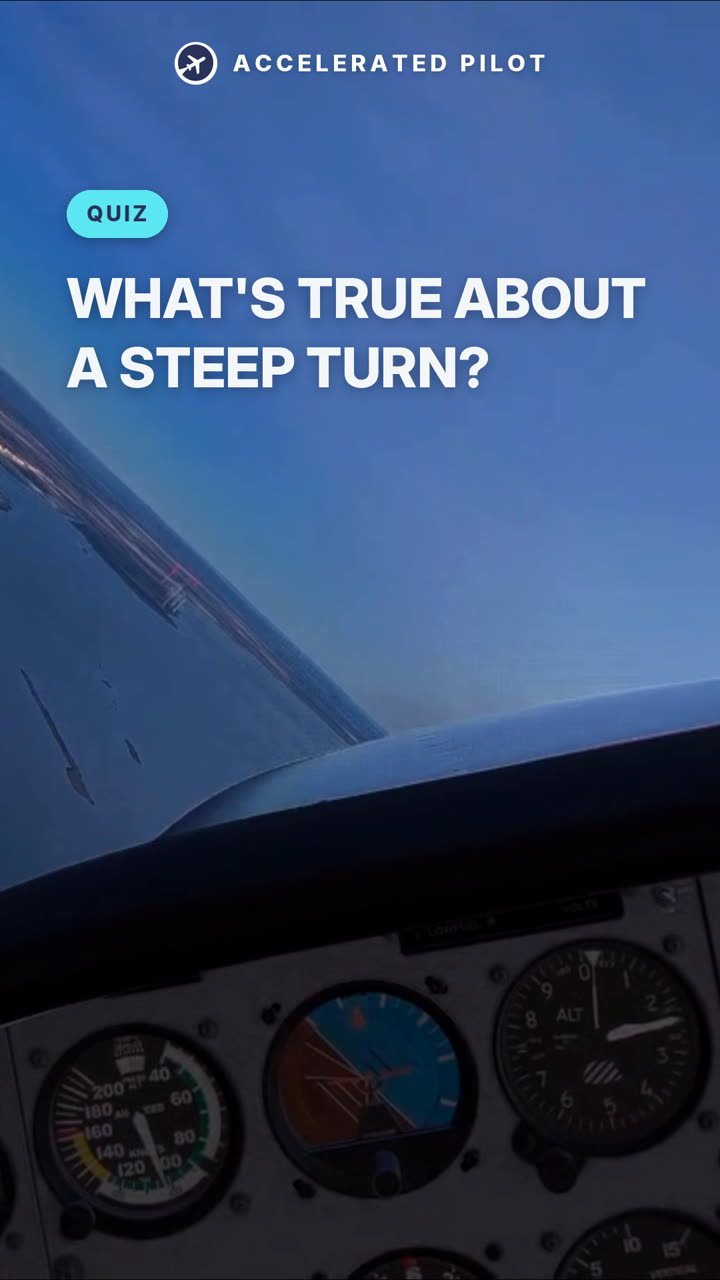
You're in a coordinated, level, 45-degree steep turn. Which of these is true about a steep turn?
Pick an answer. You can try as many as you like.
Read the full explanation
C. Stall speed increases
On the private pilot checkride, a steep turn is flown at 45 degrees of bank, coordinated, holding altitude within 100 feet. The commercial checkride uses 50 degrees.
Load factor in a level turn
In a level turn, the lift vector tilts with the wings. Part of the lift holds the airplane up (the vertical component), and part of it turns the airplane (the horizontal component). To hold altitude, the vertical component has to equal the airplane's weight, so total lift has to increase.
Load factor is the ratio of lift to weight, measured in G's. In a level turn it equals 1 divided by the cosine of the bank angle. At 45 degrees of bank that's about 1.4 G's. At 60 degrees it's 2 G's.
Why stall speed increases
Stall speed increases with the square root of the load factor. At 45 degrees of bank that's an increase of about 19 percent. At 60 degrees it's about 41 percent. An airplane that stalls at 50 knots wings level stalls at about 60 knots in a 45-degree level turn, and about 70 knots at 60 degrees.
The Vs in the POH is a 1 G number, measured wings level. Many POHs also list stall speeds by bank angle, and the load factor chart in the PHAK (Figure 5-39) shows the same relationship graphically.
What stays the same
The critical angle of attack is a property of the airfoil, designed by the manufacturer. It does not change with bank angle, so options A and B are both wrong. What changes is the airspeed at which the critical angle is reached. Producing more lift at the same airspeed takes a higher angle of attack, so in a steep turn the angle of attack sits closer to the critical angle than it would at the same airspeed wings level.
References
- Pilot's Handbook of Aeronautical Knowledge (FAA-H-8083-25C), Chapter 5: Aerodynamics of FlightSee page 5-26 for load factor and stall speed in turns, and Figure 5-39 for the load factor chart.
- Airplane Flying Handbook (FAA-H-8083-3C), Chapter 10: Performance Maneuvers PDFSee Steep Turns.
Share your thoughts / Suggest a quiz
Tell us what you thought of this quiz, or suggest a topic for a future one.


Fly the syllabus at your own pace. Practice in VR and impress your flight instructor with how fast you improve.