
When landing, who has right of way?
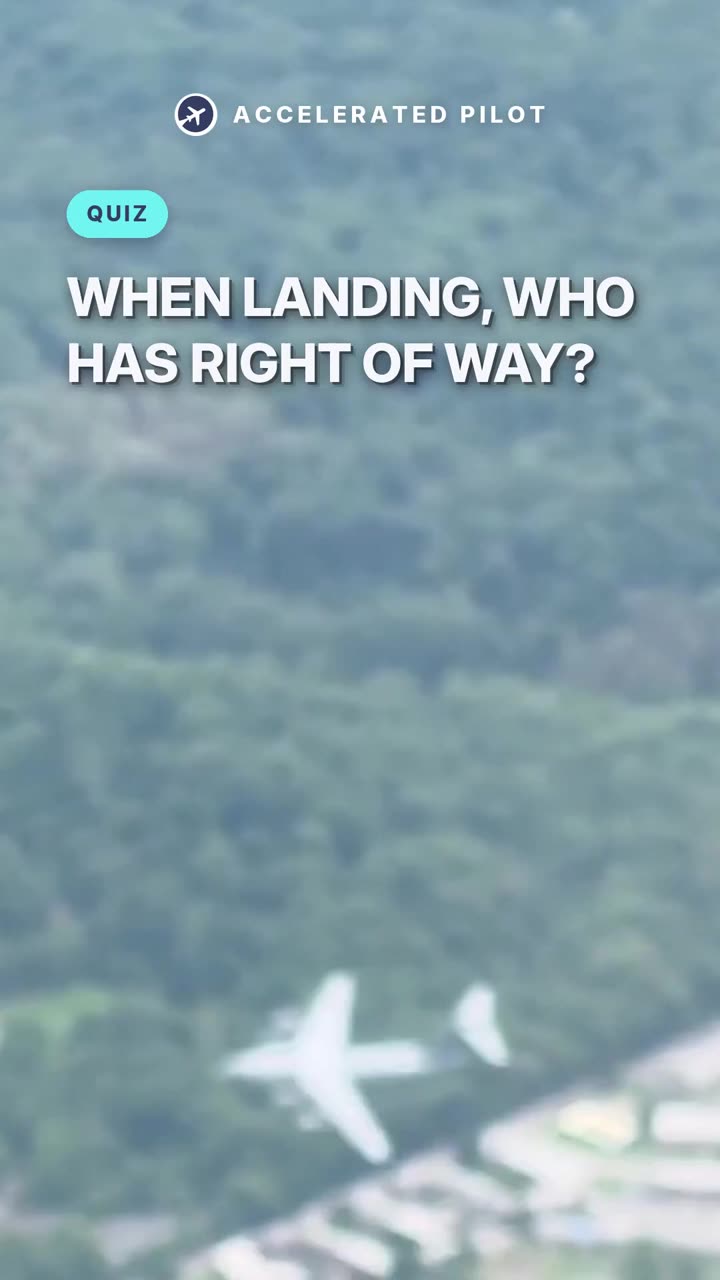
You're approaching to land and a large airplane passes right under you, headed for the same runway. When landing, who has right of way?
Pick an answer. You can try as many as you like.
Read the full explanation
C. The lower aircraft
The landing rule
14 CFR 91.113(g) covers landing. When two or more aircraft are approaching an airport to land, the aircraft at the lower altitude has the right-of-way. In this scenario, the large airplane is below you, so it has the right-of-way.
The lower aircraft can't cut in
The same paragraph limits the lower aircraft. It can't use the rule to cut in front of an aircraft that's already on final, or to overtake it. Being lower only gives you the right-of-way until someone is established on final.
Size, category and the aircraft on the right
Size isn't part of the right-of-way rules. The category order (balloon, then glider, then airship, then airplane) decides between different categories of aircraft, and both aircraft here are airplanes. The aircraft-on-the-right rule in 91.113(d) is for aircraft of the same category converging at about the same altitude. Landing has its own paragraph, and it takes precedence.
Emergencies and towered airports
An aircraft in distress has the right-of-way over all other traffic (91.113(c)). At a towered airport, the tower sets the landing sequence and you follow its instructions, but you're still responsible for seeing and avoiding other aircraft (91.113(b)).
The large airplane's wake
The large airplane has the right-of-way, and it also leaves a powerful wake. Following it to the same runway, stay at or above its final approach path, note where it touches down, and land beyond that point (AIM 7-4-6).
References
- 14 CFR 91.113, Right-of-way rules: Except water operations
- Aeronautical Information Manual, Chapter 7, Section 4: Wake TurbulenceSee 7-4-6, Vortex Avoidance Procedures.
Share your thoughts / Suggest a quiz
Tell us what you thought of this quiz, or suggest a topic for a future one.
Fly the syllabus at your own pace. Practice in VR and impress your flight instructor with how fast you improve.