
Has something failed?
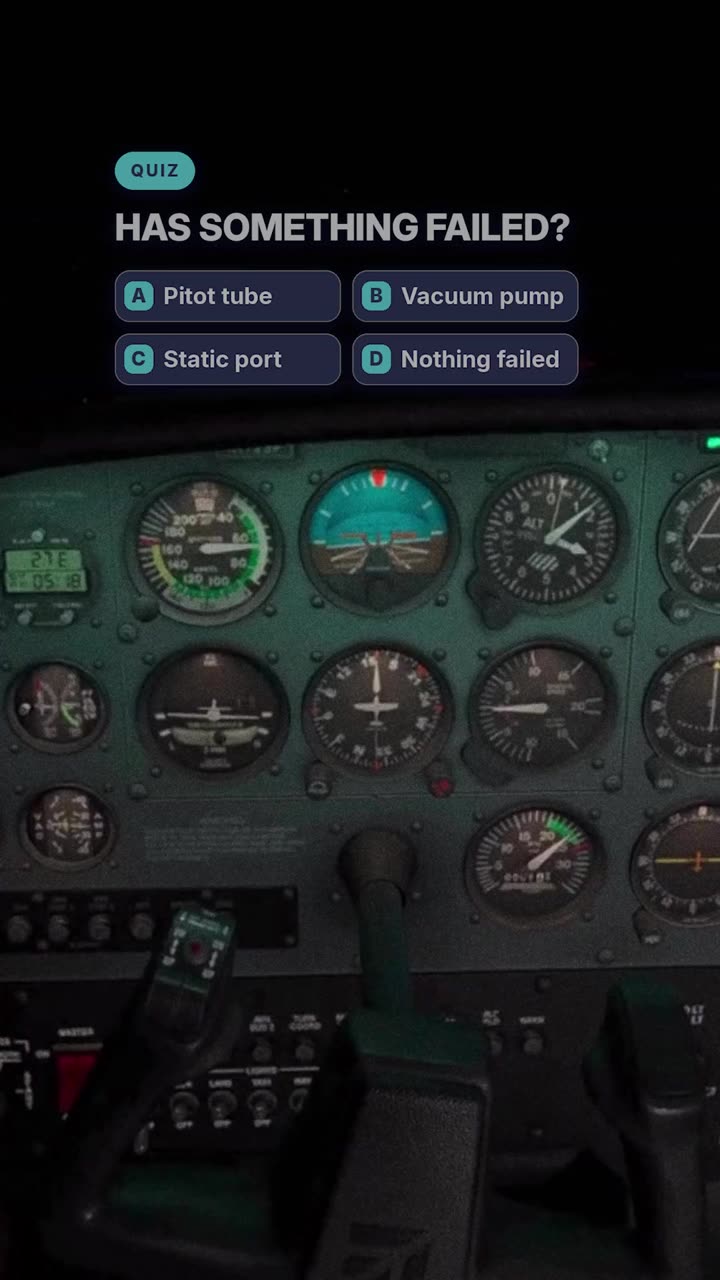
You scan the panel and see this. Has something failed?
Pick an answer. You can try as many as you like.
Read the full explanation
C. Static port
Two instruments disagree with the airplane
The attitude indicator, heading indicator and turn coordinator all show a right turn. The attitude indicator and airspeed show a climb, and with the RPM at 2450 and the nose up, a climb is what you'd expect. But the altimeter is frozen and the VSI shows level flight. Both of them read from the static port, so one blockage explains both.
When two instruments fail together
The VSI could fail on its own, but that wouldn't explain the altimeter. When instruments that share a plumbing line go wrong together, the line is a better bet than two coincidences.
The airspeed is wrong too
With the static side blocked and the pitot clear, the airspeed indicator keeps working but under-reads once you climb above the altitude where the port plugged, because the trapped static pressure is higher than the air outside. Early in a climb the error is small, which is why it doesn't jump out. The trap is chasing the low reading by lowering the nose, because descending back through the blockage altitude flips the same needle to reading high.
Why not the pitot tube or vacuum pump
A blocked pitot tube shows up on the airspeed: it reads zero, or with the drain blocked too, reads higher as you climb. A vacuum pump failure takes the attitude indicator and heading indicator down together, and here both agree with the electric turn coordinator.
References
- Pilot's Handbook of Aeronautical Knowledge (FAA-H-8083-25C), Chapter 8: Flight Instruments PDFSee "Pitot-Static Flight Instruments" and "Blockage of the Pitot-Static System."
Share your thoughts / Suggest a quiz
Tell us what you thought of this quiz, or suggest a topic for a future one.



Fly the syllabus at your own pace. Practice in VR and impress your flight instructor with how fast you improve.